王骥教授访问伦敦城市大学Ranjan Banerjee教授
在2018年暑假期间,王骥教授应英国伦敦城市大学(City, University of London)土木系J. Ranjan Banerjee教授邀请,开展在梁和飞机结构高频振动分析方面的研究工作,寻求双方合作的兴趣点。这次访问交流是在今年6月在意大利都灵的一次国际会议上交谈中约定的,因为双方都对目前的梁的高频振动的分析方法感兴趣。压电实验室最近的研究工作是一个基于Lee板理论的高阶梁理论,可以计算高阶振动频率。在伦敦城市大学大学,王骥教授和Banerjee教授讨论了技术细节,列出了一些需要深入探讨的问题,也分析了未来交流合作的形式和途径。
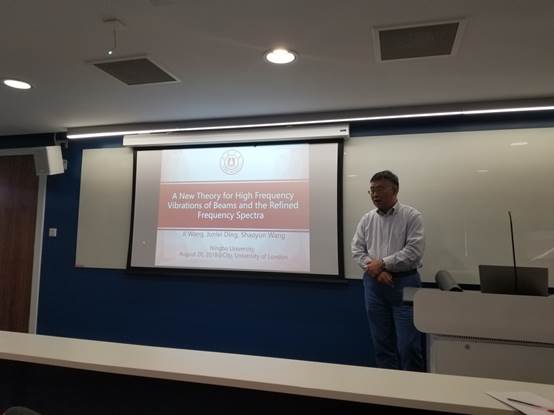
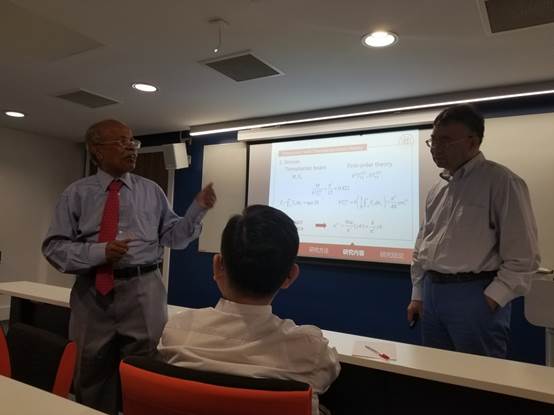
8月20日下午,王骥教授做了一场学术报告,由Banerjee教授主持。在这场报告中,王骥教授系统介绍了基于Lee位移展开的高阶梁理论的推导过程,解释了梁理论的确认和验证。然后,用一阶梁理论和Timoshenko梁进行了对比分析。这些计算也和大家熟悉的Euler-Bernoulli梁理论进行了比较,表明对于10阶以上的振动频率的准确计算,我们需要采用高阶梁理论。未来的研究工作需要继续进行验证,同时考虑梁的所有模态,用有限元分析技术进行互相验证。
In the summer of 2018, Professor Ji Wang visited City, University of London, UK at the invitation of Professor J. Ranjan Banerjee of the civil engineering program. The purpose of this visit is to explore the areas of beam theory for vibration analysis to be improved to meet the needs of high frequency vibration problems. To this goal, Professors Wang and Banerjee have reviewed current state-of-art in the high frequency vibrations of beams and frames, and suggested to make further analysis on the discrepancies, limitations, and validations for further recommendations. It is also suggested results from other techniques like the finite element analysis and analytical method like the dynamic stiffness are also utilized as part of the study involving the composite structures of aircraft and other applications.
In the afternoon of August 20, Monday, Professor Ji Wang presented a talk about the higher-order beam theory and comparison of frequency spectra of different beam theories. The new beam theory is based on the displacement expansion of Lee plate theory, which can give accurate frequencies without using correction factors as appeared in Timoshenko bean and Mindlin plate theory. A comparison suggested that the new beam theory can give frequencies very close to Timoshenko beam with the potential for further inclusion of additional higher-order thickness modes without frequency limit. It is suggested that the first ten frequencies can be obtained more accurately with the higher-order beam theories. By applying the new beam theory, the calculation of vibration frequencies of a beam can be more inclusive with actual vibration modes, warranting a more complete frequency spectra with geometry and material properties. These calculations will be further compared and verified with the finite element analysis.